


 Select A Location
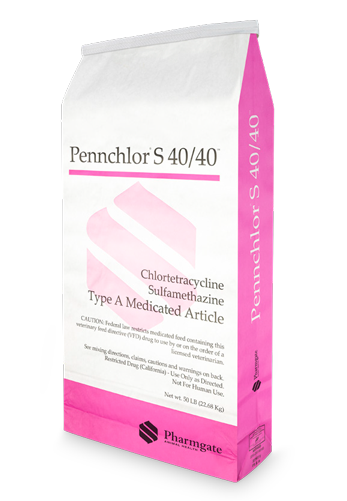
Pennchlor S 40/40
Chlortetracycline, Sulfamethazine
Type A Medicated Article

VFD Forms
Chickens
For Chickens: Control of infectious synovitis caused by Mycoplasma synoviae susceptible to chlortetracycline. (Feed continuously for 7-14 days)
Use Levels of Chlortetracycline
100-200g/ton
lbs. of Pennchlor 50® per ton
2.0-4.0 lbs.
WARNING: DO NOT FEED TO CHICKENS PRODUCING EGGS FOR HUMAN CONSUMPTION. ZERO-DAY WITHDRAWAL PERIOD.
For Chickens: Control of chronic respiratory disease (CRD) and air sac infection caused by Mycoplasma gallisepticum and Escherichia coli susceptible to chlortetracycline. (Feed continuously for 7-14 days)
Use Levels of Chlortetracycline
200-400g/ton
lbs. of Pennchlor 50® per ton
4.0-8.0 lbs.
WARNING: DO NOT FEED TO CHICKENS PRODUCING EGGS FOR HUMAN CONSUMPTION. ZERO-DAY WITHDRAWAL PERIOD.
For Chickens: Reduction of mortality due to Escherichia coli infections susceptible to chlortetracycline. (Feed for 5 days)
Use Levels of Chlortetracycline
500g/ton
lbs. of Pennchlor 50® per ton
10.0 lbs.
WARNING: DO NOT FEED TO CHICKENS PRODUCING EGGS FOR HUMAN CONSUMPTION. WITHDRAW 24 HOURS PRIOR TO SLAUGHTER.
Turkey
For Turkeys: Control of infectious synovitis caused by Mycoplasma synoviae susceptible to chlortetracycline. (Feed continuously for 7-14 days)
Use Levels of Chlortetracycline
200g/ton
lbs. of Pennchlor 50 G® per ton
4.0 lbs.
WARNING: DO NOT FEED TO TURKEYS PRODUCING EGGS FOR HUMAN CONSUMPTION. ZERO-DAY WITHDRAWAL PERIOD.
For Turkeys: Control of hexamitiasis caused by Hexamita meleagrides susceptible to chlortetracycline. (Feed continuously for 7-14 days)
Use Levels of Chlortetracycline
400g/ton
lbs. of Pennchlor 50® per ton
8.0 lbs.
WARNING: DO NOT FEED TO TURKEYS PRODUCING EGGS FOR HUMAN CONSUMPTION. ZERO-DAY WITHDRAWAL PERIOD.
For Turkey Poults Under 4 Weeks of Age: Reduction of mortality due to paratyphoid caused by Salmonella typhimurium susceptible to chlortetracycline.
Use Levels of Chlortetracycline
400g/ton
lbs. of Pennchlor 50® per ton
8.0 lbs.
For Turkeys: Control of complicating bacterial organisms associated with bluecomb (transmissible enteritis, coronaviral enteritis) susceptible to chlortetracycline. (Feed continuously for 7-14 days)
Use Levels of Chlortetracycline
25 mg/lb body weight/day
WARNING: DO NOT FEED TO TURKEYS PRODUCING EGGS FOR HUMAN CONSUMPTION. ZERO-DAY WITHDRAWAL PERIOD.
Sheep
For Breeding Sheep: Reducing the incidence of (vibrionic) abortion caused by Campylobacter fetus infection susceptible to chlortetracycline.
Use Levels of Chlortetracycline
80 mg/head/day
WARNING: ZERO-DAY WITHDRAWAL PERIOD.
Swine
For Swine: Reducing the incidence of cervical lymphadenitis (jowl abscesses) caused by Group E Streptococci susceptible to chlortetracycline.
Use Levels of Chlortetracycline
50-100g/ton
lbs. of Pennchlor 50® per ton
1.0-2.0 lbs.
For Breeding Swine: Control of leptospirosis (reducing the instances of abortions and shedding of leptospirae) caused by Leptospira pomona susceptible to chlortetracycline. (Feed continuously for not more than 14 days)
Use Levels of Chlortetracycline
400g/ton
lbs. of Pennchlor 50® per ton
8.0 lbs.
For Swine: Treatment of bacterial enteritis caused by Escherichia coli and Salmonella choleraesuis and bacterial pneumonia caused by Pasteurella multocida susceptible to chlortetracycline. (Feed for not more than 14 days)
Use Levels of Chlortetracycline
Feed approximately 400g/t, varying with body weight and feed consumption to provide 10mg/lb body weight/day
WARNING: ZERO-DAY WITHDRAWAL PERIOD.
Cattle
For Growing Cattle (Over 400 lbs.): For the reduction of the incidence of liver abscesses.
Use Levels of Chlortetracycline
70 mg/head/day
WARNING: A WITHDRAWAL PERIOD HAS NOT BEEN ESTABLISHED FOR THIS PRODUCT IN PRE-RUMINATING CALVES. DO NOT USE IN CALVES TO BE PROCESSED FOR VEAL. ZERO-DAY WITHDRAWAL PERIOD.
For Beef Cattle: For the control of bacterial pneumonia associated with shipping fever complex caused by Pasteurella spp. susceptible to chlortetracycline.
Use Levels of Chlortetracycline
350 mg/head/day
WARNING: A WITHDRAWAL PERIOD HAS NOT BEEN ESTABLISHED FOR THIS PRODUCT IN PRE-RUMINATING CALVES. DO NOT USE IN CALVES TO BE PROCESSED FOR VEAL. ZERO-DAY WITHDRAWAL PERIOD.
For Beef Cattle: For the control of bacterial pneumonia associated with shipping fever complex caused by Pasteurella spp. susceptible to chlortetracycline.
Use Levels of Chlortetracycline
350 mg/head/day
WARNING: A WITHDRAWAL PERIOD HAS NOT BEEN ESTABLISHED FOR THIS PRODUCT IN PRE-RUMINATING CALVES. DO NOT USE IN CALVES TO BE PROCESSED FOR VEAL. ZERO-DAY WITHDRAWAL PERIOD.
For Beef Cattle (Under 700 lbs.): Control of active infection of anaplasmosis caused by Anaplasma marginale susceptible to chlortetracycline.
Use Levels of Chlortetracycline
350 mg/head/day
WARNING: A WITHDRAWAL PERIOD HAS NOT BEEN ESTABLISHED FOR THIS PRODUCT IN PRE-RUMINATING CALVES. DO NOT USE IN CALVES TO BE PROCESSED FOR VEAL. ZERO-DAY WITHDRAWAL PERIOD.
For Beef Cattle (Over 700 lbs.): Control of active infection of anaplasmosis caused by Anaplasma marginale susceptible to chlortetracycline
Use Levels of Chlortetracycline
0.5 mg/lb body weight/day
WARNING: A WITHDRAWAL PERIOD HAS NOT BEEN ESTABLISHED FOR THIS PRODUCT IN PRE-RUMINATING CALVES. DO NOT USE IN CALVES TO BE PROCESSED FOR VEAL. ZERO-DAY WITHDRAWAL PERIOD.
For Calves, Beef, and Non- lactating Dairy Cattle: For treatment of bacterial enteritis caused by Escherichia coli and bacterial pneumonia caused by Pasteurella multocida susceptible to chlortetracycline. (Treat for not more than 5 days)
Use Levels of Chlortetracycline
10 mg/lb body weight/day
WARNING: A WITHDRAWAL PERIOD HAS NOT BEEN ESTABLISHED FOR THIS PRODUCT IN PRE-RUMINATING CALVES. DO NOT USE IN CALVES TO BE PROCESSED FOR VEAL. ZERO-DAY WITHDRAWAL PERIOD.
Swine
Indications:
For reduction of the incidence of cervical abscesses; treatment of bacterial swine enteritis (salmonellosis or necrotic enteritis caused by Salmonella choleraesuis and vibrionic dysentery); prevention of bacterial swine enteritis (salmonellosis or necrotic enteritis caused by Salmonella choleraesuis and vibrionic dysentery) during times of stress; maintenance of weight gains in the presence of atrophic rhinitis.
Directions for Use:
Mix at the rate of 10 lbs (4.54 kg) per ton (907.2 kg) with part of the feed ingredients to make a preblend. Add the remainder of the ingredients to give a final concentration of 100 g chlortetracycline, and 100 g sulfamethazine per ton of Type C feed and mix thoroughly.
Swine
For Use in the Manufacture of Medicated Swine Feeds: Reduction of the incidence of cervical abscesses; treatment of bacterial swine enteritis (salmonellosis or necrotic enteritis caused by Salmonella choleraesuis and vibrionic dysentery); prevention of bacterial swine enteritis (salmonellosis or necrotic enteritis caused by Salmonella choleraesuis and vibrionic dysentery) during times of stress; maintenance of weight gains in the presence of atrophic rhinitis.
Use Levels of Chlortetracycline
Mix 2.5 lbs. of Article with part of the feed ingredients to make a preblend. Add the remainder of the ingredients to give a final concentration of 100 g chlortetracycline and 100 g sulfamethazine per ton of Type C feed and mix thoroughly.
Product Description
- Antibacterial combination premix for oral administration in feed to swine for
- salmonella
- cervical abscesses
- bacterial enteritis
- atrophic rhinitis
- Each pound of premix contains 40 Grams of chlortetracycline activity and 40 Grams (8.8%) of sulfamethazine
- Free-flowing meal medicated article
- Ingredients: Chlortetracycline calcium complex, sulfamethazine, calcium carbonate, roughage products, mineral oil
- 50-lb, fuchsia color-coded bags
Key Features
- Combination of two potent antibacterial agents (chlortetracycline and sulfamethazine), providing broad-spectrum activity
- Readily absorbed, providing effective blood and lung tissue concentrations
- Free-flowing formulation promotes consistent mixing
- Wide safety margin
- Color-coded bag for easy identification
- High-quality manufacturing at US Pharmgate facilities
Label Indications and Dosage
For Use in the Manufacture of Medicated Swine Feeds: Reduction of the incidence of cervical abscesses; treatment of bacterial swine enteritis (salmonellosis or necrotic enteritis caused by Salmonella choleraesuis and vibrionic dysentery); prevention of bacterial swine enteritis (salmonellosis or necrotic enteritis caused by Salmonella choleraesuis and vibrionic dysentery) during times of stress; maintenance of weight gains in the presence of atrophic rhinitis.
Use Levels of Chlortetracycline
Mix 2.5 lbs. of Article with part of the feed ingredients to make a preblend. Add the remainder of the ingredients to give a final concentration of 100 g chlortetracycline and 100 g sulfamethazine per ton of Type C feed and mix thoroughly.
Withdrawal Period
- 15 days.
Packaging
- 50-lb, fuchsia color-coded bags.
Formulation
- Free-flowing meal medicated article.
- Ingredients: Chlortetracycline calcium complex, sulfamethazine, calcium carbonate, roughage products, mineral oil.
FDA Status
- CAUTION: Federal law restricts medicated feed containing this veterinary feed directive (VFD) drug to use by or on the order of a licensed veterinarian.
- Type A Medicated Article for use in the manufacture of swine feeds.
- Category II drug; requires a feedmill license (not required for Type B and Type C medicated feeds).
- Approved by FDA under NADA # 138-934.
Cattle
For Use in the Manufacture of Beef Cattle Feeds: As an aid in the maintenance of weight gains in the presence of respiratory disease such as shipping fever.
Use Levels of Chlortetracycline
Mix sufficient Pennchlor•S® in the feed to supply 350 mg of Chlortetracycline and 350 mg of Sulfamethazine per head per day. The following table shows the amounts of Pennchlor•S® needed for the various quantities of supplement.
Pennchlor S lb/Ton Supplement |
Supplement will contain Chlortetracycline g/ton |
Supplement will contain Sulfamethazine g/ton |
Feed Supplement at lb/Head/Day |
|---|---|---|---|
| 40 | 1400 | 1400 | 0.5 |
| 20 | 700 | 700 | 1 |
| 10 | 350 | 350 | 2 |
| 5 | 175 | 175 | 4 |
| 4 | 140 | 140 | 5 |
| 2 | 70 | 70 | 10 |
| 1 | 35 | 35 | 20 |
WARNING: WITHDRAW 7 DAYS PRIOR TO SLAUGHTER. A WITHDRAWAL PERIOD HAS NOT BEEN ESTABLISHED FOR THIS PRODUCT IN PRE-RUMINATING CALVES. DO NOT USE IN CALVES TO BE PROCESSED FOR VEAL
Cattle
For Beef Cattle (over 700 lb): For control of active infection of anaplasmosis caused by Anaplasma marginale susceptible to chlortetracycline
Use Levels of Chlortetracycline
0.5 mg/lb body weight/day
For Beef and Non-Lactating Dairy Cattle: As an aid in the control of active infection of anaplasmosis caused by Anaplasma marginale susceptible to chlortetracycline
Use Levels of Chlortetracycline
0.5-2.0 mg/lb body weight/day
For Calves, Beef, and Non-Lactating Dairy Cattle: For treatment of bacterial enteritis caused by Escherichia coli and bacterial pneumonia caused by Pasteurella multocida organisms susceptible to chlortetracycline.
Use Levels of Chlortetracycline
10 mg/lb body weight/day
Feed for not more than 5 days
WARNING: A WITHDRAWAL PERIOD HAS NOT BEEN ESTABLISHED FOR THIS PRODUCT IN PRERUMINATING CALVES. DO NOT USE IN CALVES TO BE PROCESSED FOR VEAL.
ZERO-DAY WITHDRAWAL PERIOD.
For Growing Cattle (over 400lb): For the reduction of the incidence of liver abscesses.
Use Levels of Chlortetracycline
70 mg/head/day
For Beef Cattle and Dairy Replacement Heifers: For control of bacterial pneumonia associated with shipping fever complex caused by Pasteurella spp. susceptible to chlortetracycline
Use Levels of Chlortetracycline
350 mg/head/day
For Beef Cattle (under 700 lb): For the control of active infection of anaplasmosis caused by Anaplasma marginale susceptible to chlortetracycline
Use Levels of Chlortetracycline
350 mg/head/day
WARNING: A WITHDRAWAL PERIOD HAS NOT BEEN ESTABLISHED FOR THIS PRODUCT IN PRERUMINATING CALVES. DO NOT USE IN CALVES TO BE PROCESSED FOR VEAL. ZERO-DAY WITHDRAWAL PERIOD.
Swine
For Swine: Control of porcine proliferative enteropathies (ileitis) caused by Lawsonia intracellularis susceptible to chlortetracycline. Treatment of bacterial enteritis caused be Escherichia coli and Salmonella choleraesuis and bacterial pneumonia caused by Pasteurella multocida susceptible to chlortetracycline. (Note: This drug level is equivalent to approximately 400 grams per ton, depending on feed consumption and body weight).
Use Levels of Chlortetracycline HCl
10 mg/lb body weight/day
Feed for not more than 14 days
WARNING: ZERO-DAY WITHDRAWAL PERIOD.
For Swine: Reduction in incidence of cervical lymphaderitis (jowl abscesses) caused by Group E. Streptococci susceptible to chlortetracycline
Use Levels of Chlortetracycline
50-100 g per ton in complete feed
For Breeding Swine: Control of leptospirosis (reducing the incidence of abortion and shedding of leptospirae) caused by Leptospira pomona susceptible to chlortetracycline
Use Levels of Chlortetracycline
400 g per ton in complete feed
WARNING: ZERO-DAY WITHDRAWAL PERIOD.
Chickens
For Chickens: Control of infectious synovitis caused by Mycoplasma synoviae susceptible to chlortetracycline
Use Levels of Chlortetracycline
100-200 g per ton complete feed
Feed continuously for 7 to 14 days
WARNING: ZERO-DAY WITHDRAWAL PERIOD.
For Chickens: Control of chronic respiratory disease (CRD) and air sac infection caused by Mycoplasma gallisepticum and Escherichia coli susceptible to chlortetracycline
Use Levels of Chlortetracycline
200-400 g per ton complete feed
Feed continuously for 7 to 14 days
WARNING: ZERO-DAY WITHDRAWAL PERIOD.
For Chickens: Reduction of mortality due to Escherichia coli infections susceptible to chlortetracycline
Use Levels of Chlortetracycline
500 g per ton complete feed
WARNING: ZERO-DAY WITHDRAWAL PERIOD.
For Chickens: Reduction of mortality due to Escherichia coli infections susceptible to chlortetracycline
Use Levels of Chlortetracycline
500 g per ton complete feed
WARNING: ZERO-DAY WITHDRAWAL PERIOD.
Turkeys
For Turkeys: Control of complicating bacterial organisms associated with bluecomb (transmissible enteritis, coronaviral enteritis) susceptible to chlortetracycline
Use Levels of Chlortetracycline
25mg/lb body weight/day
Feed continuously for 7 to 14 days
WARNING: DO NOT FEED TO DUCKS OR TURKEYS PRODUCING EGGS FOR HUMAN CONSUMPTION
ZERO-DAY WITHDRAWAL PERIOD
For Turkeys: Control of infectious synovitis caused by Mycoplasma synoviae susceptible to chlortetracycline.
Use Levels of Chlortetracycline
200 g per ton complete feed
Feed continuously for 7 to 14 days
For Turkeys: Control of hexamitiasis caused by Hexamita meleagridis susceptible to chlortetracycline
Use Levels of Chlortetracycline
400 g per ton complete feed
Feed continuously for 7 to 14 days
For Turkey poults not over 4 weeks of age: Reduction of mortality due to paratyphoid caused by Salmonella typhimurium susceptible to chlortetracycline
Use Levels of Chlortetracycline
400 g per ton complete feed
WARNING: Do not feed to ducks or turkeys producing eggs for human consumption
Zero-Day Withdrawal period
Ducks
For Ducks: Control and treatment of fowl cholera caused by Pasteurella multocida susceptible to chlortetracycline
Use Levels of Chlortetracycline
200-400 g per ton complete feed
Feed in complete ration to provide from 8 to 28 mg per pound of body weight per day depending on age and severity of disease.
Feed for not more than 21 days
WARNING: DO NOT FEED TO DUCKS OR TURKEYS PRODUCING EGGS FOR HUMAN CONSUMPTION
ZERO-DAY WITHDRAWAL PERIOD
Sheep
For Breeding Sheep: Reduction in the incidence of (vibrionic) abortions caused by Campylobacter fetus infection susceptible to chlortetracycline
Use Levels of Chlortetracycline
80 mg/head/day
WARNING: ZERO-DAY WITHDRAWAL PERIOD
Psittacine Birds
For Psittacine birds: Treatment of psittacine birds (parrots, macaws, cockatoos) suspected or known to be infected with psittacosis caused by Chlamydia psittaci sensitive to chlortetracycline
Use Levels of Chlortetracycline
10 mg per g of complete feed
Feed continuously for 45 days. Each bird should consume an amount of medicated feed equal to one-fifth of this body weight. During treatment, parrots, macaws, and cockatoos should be kept individually or in pairs in clean cages.
WARNING: PSITTACOSIS, AVIAN CHLAMYDIOSIS, OR ORNITHOSIS IS A REPORTABLE COMMUNICABLE DISEASE, TRANSMISSIBLE BETWEEN WILD AND DOMESTIC BIRDS, OTHER ANIMALS AND MAN. CONTACT APPROPRIATE PUBLIC HEALTH AND REGULATORY OFFICIALS.
CAUTION: ASPERGILLOSIS MAY OCCUR FOLLOWING PROLONGED TREATMENT.

Available in the USA
The labeling contains complete use information, including any cautions and warnings. Always read, understand and follow the labeling and use directions. See the reverse side for use directions and additional information.